
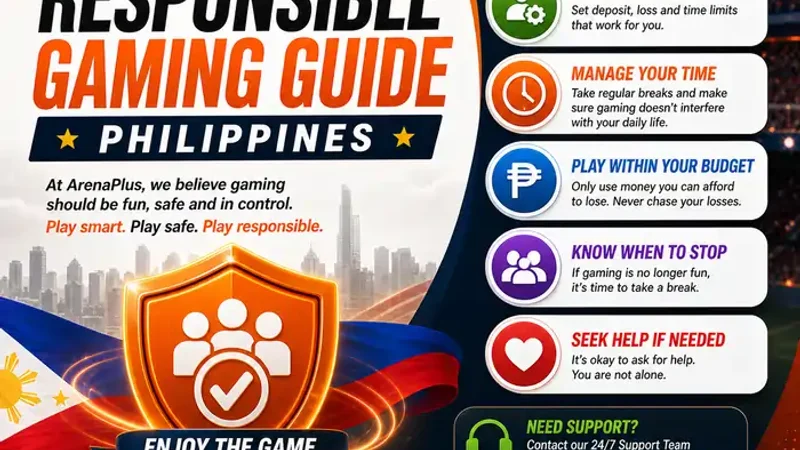
At our publication, we hold a fundamental belief: interactive gaming should always remain an enjoyable form of leisure entertainment, never a source of financial stress, emotional distress, or personal harm. While the vast majority of players engage with digital entertainment responsibly, the accessibility of modern mobile gaming applications and electronic wallets creates genuine risks of compulsive behavior and problem gambling.
This Responsible Gaming Policy details our comprehensive harm-reduction framework, provides practical self-management tools, outlines the symptoms of gambling-related harm, and connects Filipino players and their families with accredited support services across the country and worldwide.
---
Legal Age Restriction: Strict 21+ Enforcement
Under the regulatory authority of the Philippine Amusement and Gaming Corporation (PAGCOR) and national Philippine statutes, the legal gambling age is strictly 21 years old and above.
Minors are strictly prohibited from participating in any gambling activities, downloading real-money gaming applications, or opening accounts on online gaming portals.
Protecting Minors from Gaming Content
If you share your mobile device, computer, or home network with minors, we strongly recommend implementing the following digital safeguards:- Parental Filtering Software: Install content filtering applications such as Net Nanny, Qustodio, or Google Family Link to block access to real-money gaming platforms on shared family devices.
- Credential Isolation: Never store casino usernames, passwords, or e-wallet PINs in auto-fill browsers accessible to underage household members.
- Financial Access Controls: Protect your GCash and Maya accounts with biometric authentication (fingerprint or Face ID) and two-factor SMS verification so children cannot initiate deposits.
Understanding the House Edge: The Mathematical Reality
A healthy relationship with casino gaming begins with an honest understanding of the underlying mathematics. Every commercial casino game—whether it is a JILI electronic slot machine like Super Ace, an online baccarat table, or a digital color game—is engineered with a built-in mathematical advantage known as the House Edge.
- Return to Player (RTP) is Theoretical: A slot machine with a 97.00% RTP means that over hundreds of millions of simulated spins, the game is programmed to retain 3.00% of all wagered money as operator revenue.
- Short-Term Variance is Not an Edge: While individual players experience winning streaks in short sessions due to volatility, long-term continuous play inevitably gravitates toward the mathematical house advantage.
- Gambling is Not an Investment: Wagering real currency on casino games should never be viewed as an income strategy, a side hustle, or a method to resolve financial debt. Money spent on gaming should be budgeted strictly as an entertainment expense, similar to purchasing a concert ticket or dining at a restaurant.
Self-Assessment: Recognizing the Warning Signs of Problem Gambling
Compulsive gambling develops gradually, often without the individual realizing that their recreational habit has transitioned into harmful behavior. To evaluate your relationship with gaming, honestly review the following ten self-assessment questions:
1. Do you spend more money on gaming than you originally budgeted or can afford to lose? 2. Have you ever borrowed money, taken out online loans, or sold personal belongings to fund gaming? 3. Do you find yourself "chasing losses"—depositing additional funds immediately to win back money you just lost? 4. Has gaming ever caused you to neglect work obligations, family responsibilities, or school attendance? 5. Do you play casino games as an escape from personal stress, anxiety, depression, or loneliness? 6. Have you ever lied to family members or close friends about the amount of time or money you spend gaming? 7. Do you feel restless, irritable, or anxious when attempting to cut down or stop playing? 8. Have you ever used household budget money intended for rent, groceries, bills, or tuition to place bets? 9. Do you celebrate wins by wagering even larger amounts rather than withdrawing your profits? 10. Have you continued to gamble after experiencing repeated financial losses that impacted your daily livelihood?
If you answered "Yes" to two or more of these questions, you may be experiencing symptoms of problem gambling. We urge you to take immediate protective measures using the tools and resources detailed below.
---
Practical Tools for Maintaining Control
Modern gaming operators provide built-in player protection features within their account settings. We strongly advocate utilizing these tools before placing your first wager:
| Player Protection Tool | How It Operates | Recommended Configuration |
|---|---|---|
| Deposit Ceilings | Enforces a hard monetary limit on the total cash-in amount permitted within 24 hours, 7 days, or 30 days. | Set your limit to no more than 5% of your monthly discretionary entertainment budget. |
| Session Time Limits | Displays automated on-screen notifications reminding you of total elapsed gaming time. | Configure alerts every 30 to 45 minutes to encourage regular breaks away from screens. |
| Loss Limits | Automatically suspends your ability to place wagers if your net losses reach a pre-set ceiling during a single session. | Set a loss limit equal to your single-session entertainment allocation. |
| Cooling-Off Periods | Temporarily locks your gaming account for a designated duration (24 hours to 30 days) during periods of high stress. | Activate immediately following an emotional loss to prevent reckless chasing. |
| Self-Exclusion | Formally closes your account and bans you from logging in, depositing, or receiving marketing materials for 6 months to 5 years. | Recommended for any player showing signs of compulsive wagering behavior. |
---
National and International Support Organizations
If you or a loved one is struggling with gambling-related harm, confidential and professional help is accessible right now. You do not have to face this challenge alone.
Philippine National Support
- PAGCOR Responsible Gaming Directorate: The regulatory authority operates a dedicated Responsible Gaming division providing formal self-exclusion programs across all licensed land-based and electronic gaming establishments in the Philippines. Visit PAGCOR to download the official National Self-Exclusion Program (NDF-RG) application form.
- National Center for Mental Health (NCMH) Crisis Hotline: Provides 24/7 free, confidential psychological support and counseling for individuals experiencing acute distress. Hotline: 1553 (Luzon-wide toll-free) or (02) 8531-9001.
International Counseling and Support Communities
- Gamblers Anonymous: A worldwide fellowship of men and women who share their experience, strength, and hope to overcome gambling addiction together. GA hosts both in-person and digital 12-step support meetings across the globe. Visit Gamblers Anonymous to locate virtual meetings.
- GamCare: The leading international provider of information, advice, and confidential support for anyone affected by problem gambling. Operates live web chat services and moderated support forums. Access resources at GamCare.
- Gambling Therapy: Offers free multilingual global online support services, including peer support chat groups, practical self-help exercises, and email therapy.
Technical Blocking Software for Devices
For players seeking complete digital disconnection from real-money gaming platforms, installing dedicated third-party blocking applications provides an essential barrier:
- BetBlocker: A completely free, non-profit software application that blocks access to tens of thousands of gambling websites and applications across Android, iOS, Windows, and macOS devices. It cannot be switched off during the restriction period.
- Gamban: A specialized device blocking utility that prevents access to online casinos, sportsbooks, and betting portals on personal smartphones and laptops.